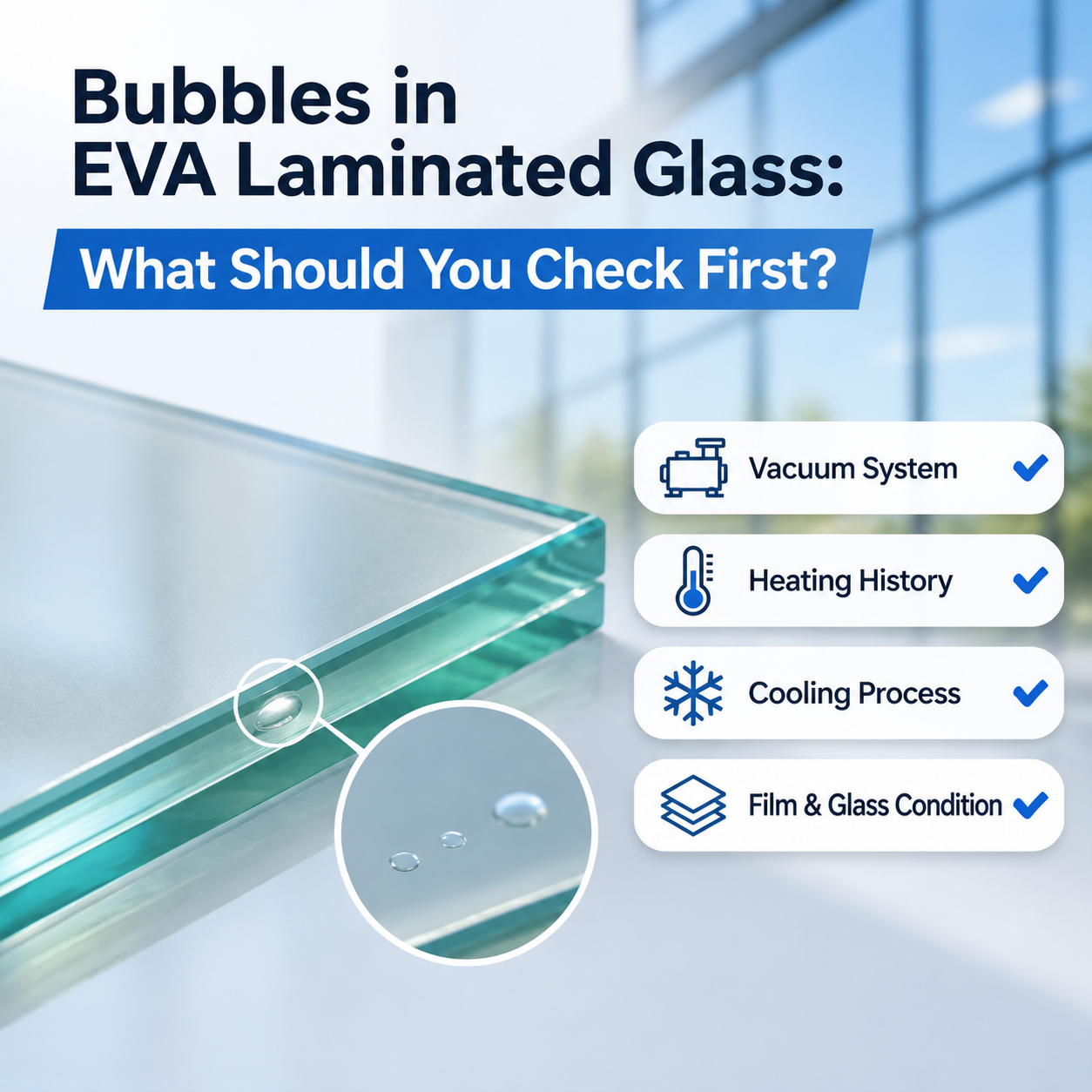


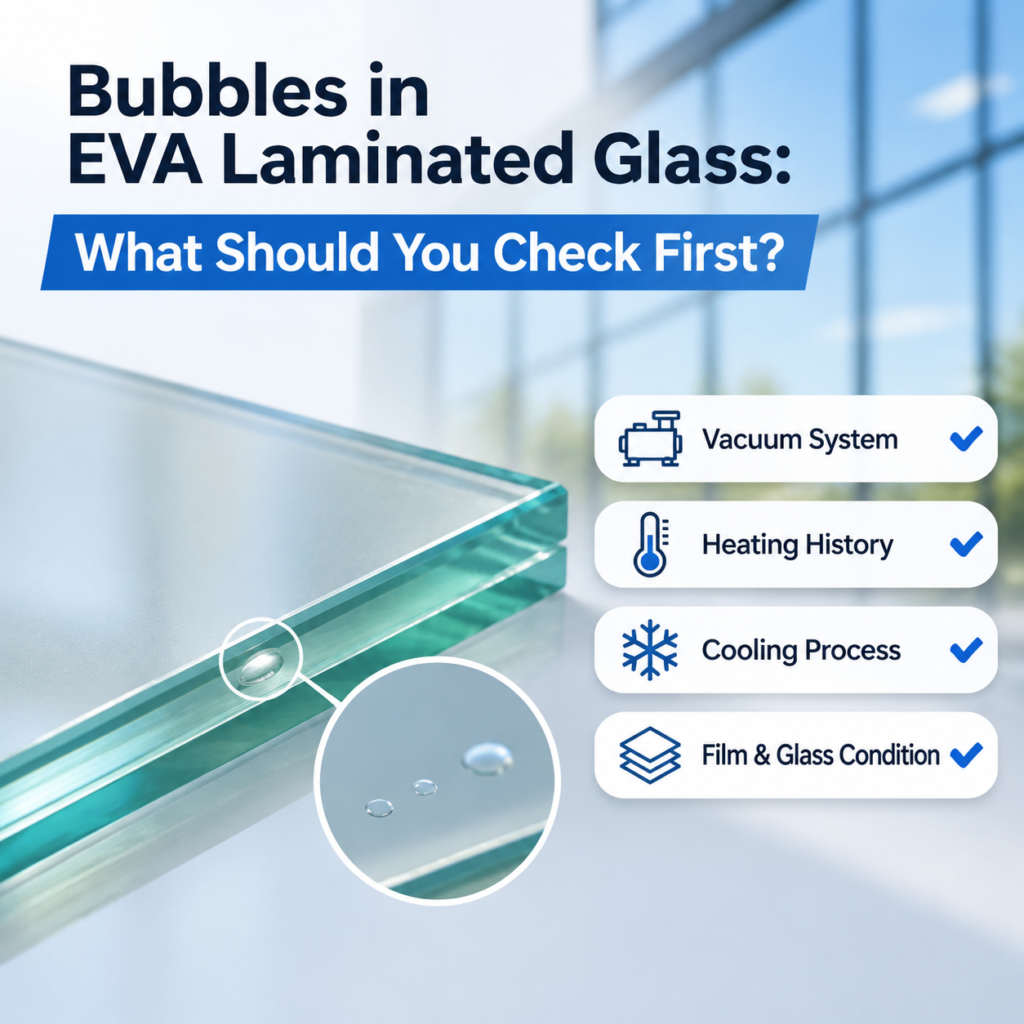
When bubbles appear in EVA laminated glass, start by recording where they are and when they became visible. Then check the vacuum system, the actual heating history and the cooling sequence against the instructions for the EVA grade being used. Changing the film or increasing the oven temperature before collecting this evidence can make the next result harder to explain.
The aim is to find a repeatable cause, rather than a setting that happens to produce one clear panel. The following sequence is a practical investigation framework for glass processors using EVA vacuum lamination. It is not a universal processing recipe.
First, turn the defect into a usable record
Before adjusting the next load, photograph the affected panels and mark their orientation in the oven. Record whether the bubbles are near the edges, concentrated in the centre, scattered across the panel or located around an insert.
Also record when the defect was first observed: after cooling, after storage or after installation. If nobody inspected the panel earlier, write “first observed” rather than assuming when the bubbles formed.
Connect each photograph to the glass construction, EVA grade, batch and roll number, equipment and cycle record. Include an accepted panel from the same production period where available. This gives the investigation something concrete to compare.
Use bubble location to choose the next check
| Observation | First investigation | Evidence to collect |
| Bubbles in the central area | Vacuum integrity and evacuation arrangement | Bag condition, connections and vacuum record |
| Bubbles concentrated near edges | Cooling and vacuum-release sequence | Temperature measurement location and release timing |
| A repeated pattern in one oven position | Equipment or loading differences | Panel positions and temperature records |
| Defects around an insert | Construction and material compatibility | Insert identity, preparation and comparison sample |
| A change after opening a new roll | Material and handling changes alongside process records | Grade, lot, storage history and previous accepted production |
These are investigation priorities, not diagnoses. Location helps decide what to examine; it cannot establish the cause by itself.
Check the vacuum system before changing the heating program
Inspect the bag or silicone membrane, seals, hose connections and routing. Look for damage, a poorly seated connection or a hose restricted by the loading arrangement. Follow the equipment supplier’s procedure for checking performance under operating conditions.
An EVA manufacturer’s troubleshooting guide identifies vacuum-system faults among possible explanations for central bubbles and highlights cooling and vacuum-release timing for edge bubbles. Its guidance applies to its products and processing setup; it supports these checks, not a universal diagnosis.
Do not rely only on a remembered vacuum reading. Record when and where it was measured and whether it remained consistent during the relevant stages. If the system behaves differently with a loaded bag, that difference needs investigation before a film comparison will be meaningful.
Verify what temperature the laminate actually experienced
The oven display is one measurement point. Establish whether the processing instructions refer to oven air, the glass surface or the interlayer, and how the required condition should be verified.
The manufacturer’s Argotec EVA application guide explains that interlayer temperature can lag behind the lamination device temperature. Its formulation-specific data illustrate why a controller setting should not be treated as proof of the film’s temperature history.
For your own production, use the selected grade’s current instructions and an agreed measurement method. Compare the affected construction and load arrangement with previously accepted work. A cycle used for one construction should not automatically be extended to a thicker panel, additional layers or a different insert.
Increasing heat is not a diagnosis. First identify which measured condition differs from the approved process.
Review cooling, preparation and anything that changed
Check the cooling record and the point at which vacuum was released. Compare both with the film and equipment instructions. Avoid adopting another manufacturer’s release temperature without confirming that it applies to your system.
Next, review glass preparation, drying, film handling and any decorative or functional insert. Ask what changed since the last accepted load: a cleaning product, storage location, opened roll, insert, operator practice or loading pattern.
Treat these changes as hypotheses to test. For an insert-related problem, discuss a suitable comparison panel without the insert with the material supplier. For a suspected handling issue, document the handling difference rather than simply labelling the film “wet” or “contaminated.”
Should you switch to a higher-flow EVA?
A different flow characteristic may be worth evaluating when the construction needs different material movement during lamination. It does not replace vacuum or process checks.
E&N HONJIA presents HJ-AT as a high-flow EVA option, while explaining that selection depends on the glass structure and processing conditions. Consider a grade change as a documented trial with the supplier, rather than a guaranteed bubble remedy.
Run the next trial so it answers one question
Write down the suspected cause, the evidence behind it and the change you intend to test. Keep the other relevant conditions comparable where practicable. Record unavoidable differences.
Agree on inspection timing and acceptance criteria before the trial. Report all outcomes, including unsuccessful panels. If several settings and materials change together, a better result may be useful operationally, but it will provide limited evidence about which change mattered.
Do not assume that reheating a bubbled panel will make it acceptable. Obtain product-specific guidance and define how any proposed rework would be assessed before attempting it.
What to send your EVA supplier
A useful technical enquiry includes:
- Photographs showing bubble location, scale and panel orientation.
- Glass construction, dimensions, coatings and inserts.
- EVA grade, thickness, batch, roll and handling history.
- Vacuum, heating and cooling records, with measurement locations.
- When the defect was first observed and what changed from accepted production.
To discuss an EVA selection or processing question, contact E&N HONJIA with this information. A documented description gives the discussion a clearer starting point than “the film has bubbles.”
Frequently asked questions
Do bubbles always mean the EVA film is defective?
No. Investigate the material, construction and process together. A defect associated with a roll warrants checking, but association alone does not identify the mechanism.
- Is there one temperature that prevents EVA lamination bubbles?
Use the instructions for the exact grade and construction. A temperature copied from another product is not a validated setting for your production.
- Can clear appearance alone confirm an acceptable laminate?
Visual inspection addresses appearance. It does not replace the adhesion, durability or finished-glass verification required for the intended application.