

Choose an EVA interlayer for decorative glass by checking the actual insert, the intended environment, the glass build-up and the required appearance together. Then compare suitable film grades through trials using your own materials and equipment. A clear film, a colored film or a higher-flow grade should be selected for a defined requirement, rather than treated as a universal solution.
For buyers, the useful starting point is a complete description of the panel. A fabric partition, a metal mesh feature panel and printed decorative glass may require different evaluations even when their overall dimensions are similar.
Start with the application and decorative material
Tell your supplier whether the glass will be used indoors or outdoors and describe its installation, edge exposure and intended market. An outdoor film designation does not establish the suitability of every decorative insert or certify the finished glass assembly.
Decorative laminated glass is a complete material system. The insert’s composition, thickness, finish and condition must be assessed alongside the EVA and glass. Trial results for one material should not automatically be applied to a replacement from another supplier or batch.
Fabric laminated glass
Identify the fiber composition, weave, dyes, coatings and backing. Record whether the fabric is dry and clean, and whether it has been stored or treated in a way that could change its condition. Ask the fabric supplier about its suitability for the proposed thermal process.
Evaluate the finished sample for the intended texture, color, positioning and visible defects. Do not approve a fabric by appearance alone: agreement on the required bonding and durability assessment is also necessary. Compatibility with the exact fabric remains subject to testing.
Metal mesh laminated glass
Specify the metal or alloy, coating, wire diameter, mesh opening and overall thickness, including raised intersections. Provide a sample showing the actual surface condition and edge details.
For the trial, agree on the acceptable mesh position, coverage around the insert and finished edge appearance. Film selection must account for the structure around the mesh, rather than relying only on nominal wire diameter. No mesh type is automatically approved for use with EVA.
Printed decorative glass
Clarify whether the image is printed directly onto glass or carried on an inserted film. Identify the ink system, carrier, printed side, surface treatment and any curing or drying requirements specified by its supplier.
Review whether the image changes after lamination and whether the printed interface meets the agreed acceptance criteria. A successful trial with one ink or carrier does not qualify another formulation.
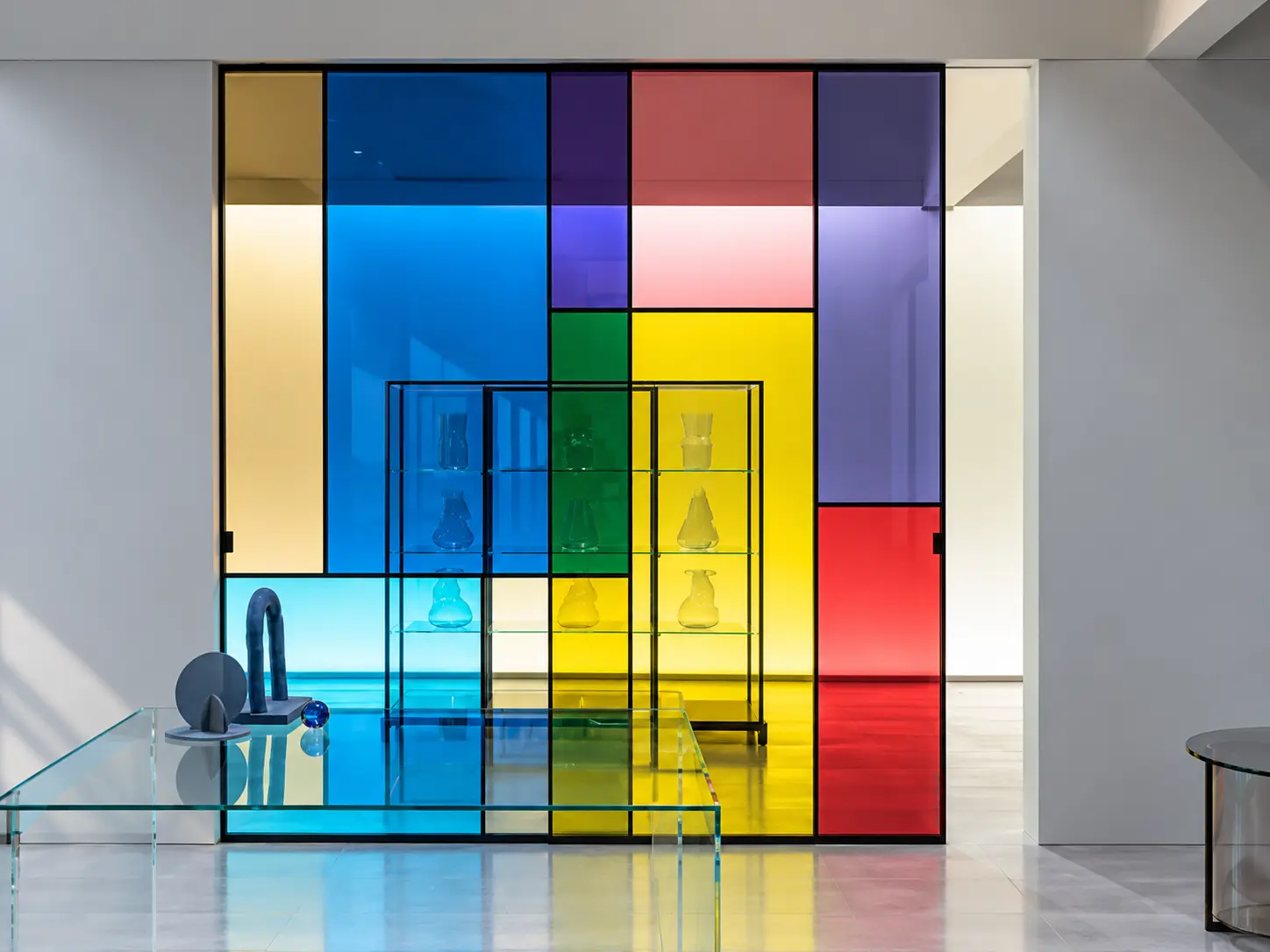
Colored decorative laminated glass
Decide whether color should come from the interlayer itself, the insert or the glass. Evaluate a laminated sample with the actual glass combination and expected lighting. Agree on the desired privacy, light transmission and appearance without assuming that a color name establishes a measured optical value.
Other decorative inserts
Paper, coated sheets and other inserts need the same material-specific review. Identify every layer, finish and adhesive already present in the insert. Ask for a compatibility review before committing to production; a decorative material category alone is insufficient evidence of suitability.
Compare high-flow and low-flow EVA under relevant conditions
High-flow EVA film and low-flow EVA film describe relative flow behavior during processing. These descriptions need a reference condition: temperature history, time, film construction and the glass assembly all matter. Ask for the supplier’s grade-specific technical guidance and comparison method instead of assuming that flow labels are standardized across brands.
Flow can affect how material redistributes around an insert and at the panel edge. Depending on the lay-up and process, insert movement, local film distribution and edge overflow are issues to investigate in trials. These are evaluation points, not guaranteed effects or verified differences between E&N grades.
| Selection point | Higher-flow candidate | Lower-flow candidate |
| Reason to investigate | Evaluate redistribution around the proposed insert | Evaluate control of redistribution and edge behavior |
| Trial observations | Insert alignment, local coverage and edge overflow | Insert alignment, local coverage and edge condition |
| What cannot be assumed | Higher flow guarantees complete bonding or a better finish | Lower flow guarantees no movement or no edge cleaning |
| Decision basis | Actual assembly and agreed sample acceptance criteria | Actual assembly and agreed sample acceptance criteria |
A manufacturer example illustrates why flow deserves attention: Evalam describes reduced edge cleaning as a feature of its own N-Fluent formulation. This supports asking about edge behavior, but does not establish equivalent performance for another brand or grade. [S2](https://www.evalam.net/en/productos/evalam-n-fluent/)
E&N HONJIA clear grade starting points
| Grade | Supplied product positioning | Selection boundary |
| HJ-WB | Indoor clear EVA | Consider for indoor applications; validate the complete decorative assembly |
| HJ-AT | Outdoor clear EVA with high flow | Discuss where a higher-flow candidate should be trialed |
| HJ-HT | Outdoor clear EVA with low flow | Discuss where a lower-flow candidate should be trialed |
These are starting points for a supplier discussion. They are not a verified ranking of adhesion, clarity, weathering resistance or insert compatibility. Do not infer the flow category of HJ-WB from this table.
Choose clear or colored EVA for the intended appearance
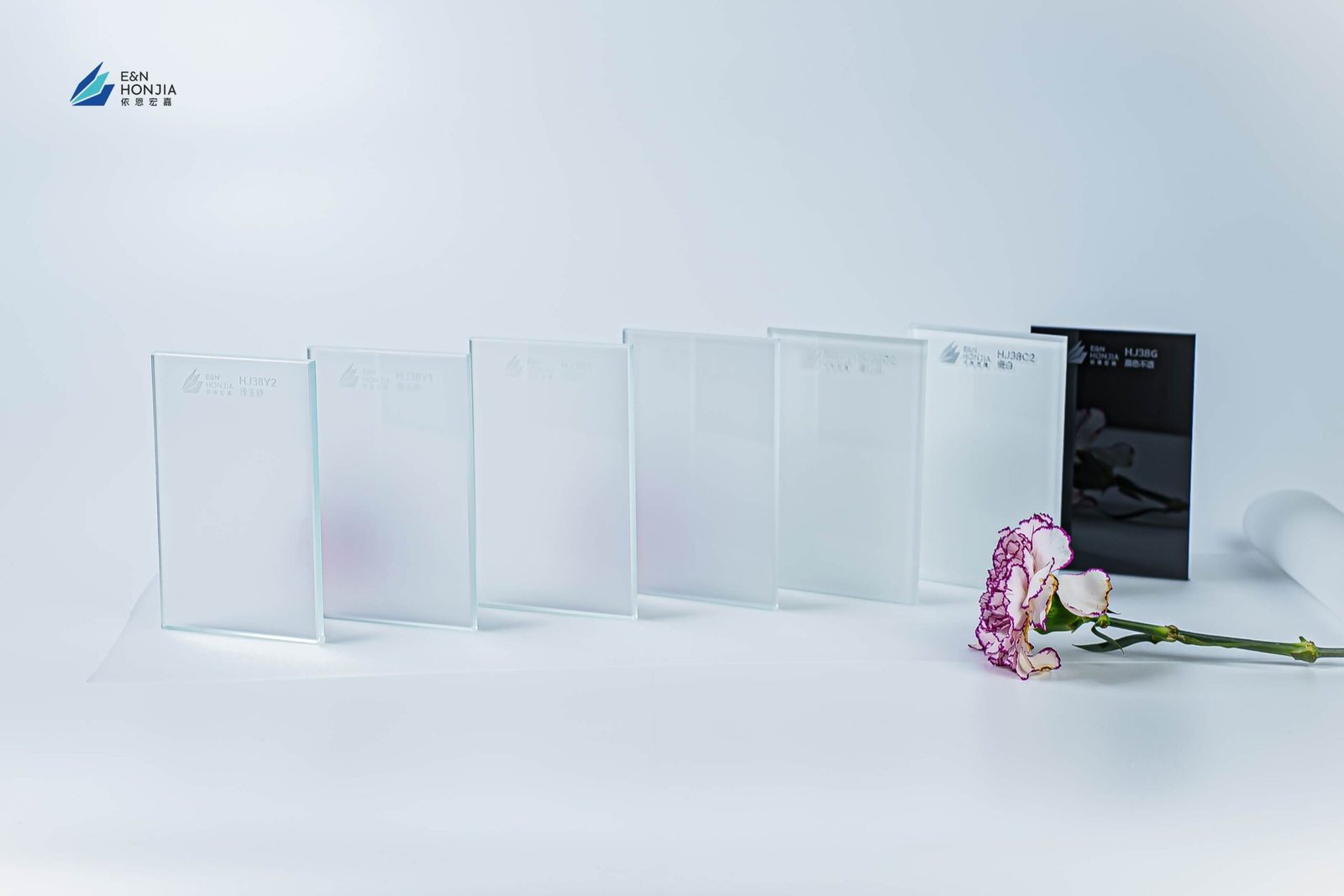
Clear EVA is a starting point when the design should show the insert through the glass. Colored EVA interlayer is an option when the film itself should contribute a white, frosted or opaque appearance. Confirm the visual result in the complete laminated panel rather than from a loose film swatch alone.
| Appearance direction | E&N HONJIA options | What to agree on |
| Deep white | HJ-C | Required appearance against the actual glass and insert |
| Porcelain white | HJ-C2 | Approved laminated reference sample |
| Frosted white | HJ-D | Desired screening and visual texture |
| Jade or sandblasted white appearance | HJ-Y; HJ-Y2 for a lighter version | Sample approval under expected lighting |
| Deeper jade or sandblasted appearance | HJ-D2; HJ-S | Confirm the distinction between the two grades |
| Opaque black | HJ-G | Required opacity and finished appearance |
English color descriptions are working translations of the supplied Chinese names. Confirm the supplier’s commercial naming and samples before ordering. A white or frosted appearance does not establish a particular haze, light transmission or privacy rating.
Confirm the build-up and process before placing an order
Provide a drawing that identifies each glass sheet, each EVA layer and the insert. State whether film thickness refers to one layer or the total film stack. Common E&N EVA thicknesses are 0.38 mm and 0.76 mm; the supplied overall product limits are up to 1.52 mm thickness and 2600 mm width. Availability of a particular grade, color, width and thickness combination must be confirmed.
Do not select film thickness solely by matching it to insert thickness. Review raised features, local thickness variation, panel dimensions and the proposed process with the supplier. There is no universal film thickness recommendation for every decorative structure in this guide.
Processing information to provide
Describe the heating and vacuum equipment, how the cycle is controlled and monitored, the current validated process where available, and material storage and preparation. Check surface cleanliness, moisture condition and the insert supplier’s handling requirements. Do not apply an unrelated supplier’s temperature, time or pressure settings to an E&N grade.
Agree on a sample approval plan
Use the intended glass, insert and film grade for the trial. Record material identities, batch details, lay-up, equipment and actual process conditions. Agree in advance on appearance, insert alignment, edge condition and the bonding or durability evaluations required for the application.
Inspect and document the sample before moving to larger panels or production. Changes to the insert, coating, dimensions or process may require a further review. A visually acceptable sample alone does not demonstrate compliance with every destination-market requirement.
Buyer checklist for an accurate EVA inquiry
| Information | What to send |
| Glass application | Partition, decorative panel or other use; installation details |
| Indoor or outdoor use | Exposure conditions and edge arrangement |
| Glass dimensions | Length and width of finished panels |
| Glass thickness | Thickness and type of each glass sheet; full build-up |
| Decorative material type | Composition, finish, thickness, supplier information and sample |
| EVA thickness | Proposed thickness per layer; identify any open selection question |
| Transparency or color requirements | Clear, white, frosted or opaque black; reference sample if available |
| Estimated order quantity | Quantity with units, and proposed roll requirements |
| Destination market | Country and applicable project or compliance requirements |
| Processing equipment | Heating and vacuum system, process records if available |
Discuss your decorative glass project with E&N HONJIA
Foshan E&N HONJIA New Material Co., Ltd. manufactures EVA laminated glass interlayer film and SGP ionoplast interlayer film. For decorative EVA selection, the useful next step is to review your complete assembly and sample requirements.
Send E&N HONJIA your glass build-up, decorative material details, panel dimensions, required EVA thickness and estimated quantity. Include the intended environment and destination market so the team can discuss suitable EVA grade candidates and a sample testing plan. Final selection depends on review of the actual materials and processing conditions.
Frequently asked questions
Is high-flow EVA always better for decorative laminated glass?
No. Flow is one selection factor. Evaluate the actual insert, lay-up, processing conditions, alignment and edge requirements. Neither flow category guarantees the best result for every construction.
Can any fabric or metal mesh be laminated with EVA?
Compatibility must be checked for the exact material, including its finish, thickness and condition. Obtain supplier information and test the proposed assembly before production.
Should I use clear EVA or colored EVA?
Start with the required appearance. Clear EVA is a candidate when the insert should remain visible; colored EVA contributes its own visual effect. Approve a laminated sample with the actual glass and lighting conditions.
Can HJ-WB be specified for outdoor use?
The supplied positioning is indoor clear EVA. Discuss HJ-AT or HJ-HT as outdoor clear candidates with E&N, while separately validating the insert and complete glass assembly.
Is 0.76 mm EVA enough for a thick decorative insert?
Thickness alone does not answer this question. Provide the insert profile and full build-up for technical review. This guide does not approve a universal film thickness for thick inserts.
What should I send before requesting a quotation?
Send the application, exposure conditions, glass size and thickness, insert details, desired film thickness and color, quantity and destination market. Equipment information and a representative insert sample help make the discussion more specific.